Every week, the Lab selects a document or project deemed particularly interesting and relevant and presents it in a few lines. This week, the Lab is going "Fab" and is focusing on FABLABs, these ecosystems of digital, open, and collaborative manufacturing. A bio-inspired approach to manufacturing soon to be essential in the landscape of innovation in France and around the world.
FABLABs, spaces for polymorphic co-creation working in networks… An example of bioinspiration!
What is a FABLAB?
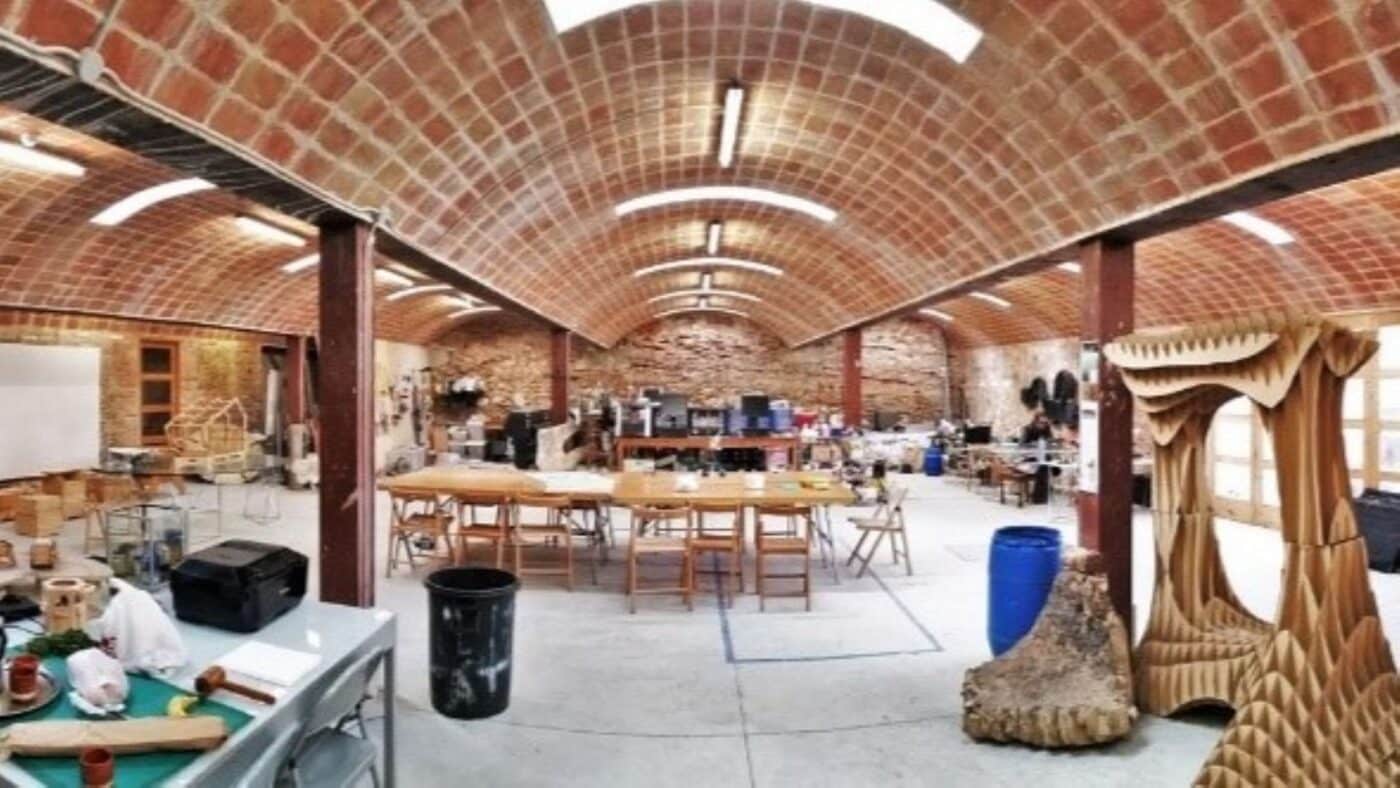
A FABLAB, or Fabrication Laboratory, is a place for exchange, offering a range of tools, machines, and know-how that enable the transition from an idea to a realization with the support of a community.
FABLABs can be associative, self-financed, and they can also be linked to a university, a public institution, or a company. Some are located in a hallway in Ménilmontant, the small Fab, others occupy a barn deep in the fjords of Norway MIT Norway, and some are even mobile and have traveled from Lorient to Marseille LAB-REV.. Depending on their resources, FABLABs generally offer a subscription model granting access to their services and events, may rely on crowdfunding, while regularly organizing open days allowing the general public to discover these third places of open innovation. Beyond this broad definition and diversity, FABLABs are recognized around a founding idea: that of a place offering free access to production technologies that were still inaccessible to the public a few years ago and sharing knowledge within an international network. To date, this network comprises 974 recognized locations, linked to the charter of FABLABs from the Massachusetts Institute of Technology (MIT).
The role of MIT in the emergence of FABLABs
Le concept de FABLAB est apparu grâce au succès inattendu d’un cours donné en 1998 par Neil Gershenfeld, professeur au MIT et intitulé “How To Make (almost) Anything » / « Comment fabriquer (presque) n’importe quoi ». Ce cours, proposant à quelques élèves d’accéder à un atelier du MIT pour tester des machines de fabrication numérique (découpeuses laser, fraiseuses numériques et autres imprimantes 3D) a très vite attiré une foule d’étudiants, séduits par l’aspect pratique de ces ateliers en rupture d’un enseignement classique et très théorique proposé alors par le MIT.
A few years later, what was meant to be a pedagogical experiment transformed into a global network; a network whose representatives are already among you.
A global network… and Makers near you
With 129 recognized FABLABs, France has the largest Makers community in Europe, and one of the largest in the world, just behind the United States (138 FABLABs). Makers are those regular or occasional users of FABLABs, enthusiasts of "DIY 3.0", with a strong digital, social, and collaborative component, propelled by the internet and its constant flow of idea sharing. These Makers and these FABLABs, Vertigo Lab have met.
Each domain has its FABLAB, each FABLAB has its objective
Opening universities
In Brest, Yves Quéré, a lecturer at the University of Western Brittany (UBO), teaching in the electronics department and researcher at Lab-STICC, created the Open Factory, a university FABLAB open to students, researchers, and the public. Inspired by the research themes of its host university, the Open Factory has allowed an entire community to work on the development of projects with varied ambitions, ranging from the manufacturing of low-energy drones to luminous vests for cyclists, and home automation.


Example: The OpenBeeHive project developed collaboratively among several FABLABs offers freely accessible plans for beehives, downloadable online and can then be manufactured in any FABLAB equipped with a laser cutter.
Awakening the community to science through FABLABs
In Bordeaux, the Cap Sciences space opened FABLAB 127°, a place offering both professionals, designers, and creators access to manufacturing machines allowing for rapid prototyping of their creations, as well as educational workshops and camps for children. These creations are then integrated into the discovery path of visitors to this place dedicated to scientific culture.
Inspiring entrepreneurship through FABLABs
In Dax, the business incubator Pulseo is connected to the Art3factlab, a FABLAB very active in "bioinspired" prototyping and offering its skills in projects aimed at using forms from nature in architecture or robotics.
Vertigo Lab hack Dax!
As part of its work with the Grand Dax community, Vertigo Lab is organizing a "hack the city", a lightning meeting aimed at bringing together farmers, FABLABs, business incubators, and city services to brainstorm bio-inspired project ideas and connect these different links in a territory labeled as energy positive. More info on October 25 on Twitter with the thread #HackDax
This connection and the use of a FABLAB, a place of open innovation, with the goal of a business project is not unnatural. Another example in Montreuil, with the FABLAB ICI Montreuil clearly dedicated to supporting startups and artisans.
Its co-founder Emmanuel Beaufils, also co-founder of the communication agency Uzful, confirms, "Some projects would never have emerged without this skills enhancement (enabled by the FABLAB). Now, we systematically think Arduino [1], 3D printer, and we increasingly present a prototype in our presentations. A demonstration is worth more than 100 slides!" Read the full article here.
Other fields, such as health, biology, and rurality are opening up to FABLAB culture to foster new ideas through the meeting of users, researchers, and Makers, to test new solutions and inspire a new generation of entrepreneurs.
Vertigo Lab and bioinspired open innovation
As part of its research on open innovation and bioinspiration, Vertigo Lab is working on connecting FABLABs, business incubators, and various sectors of the rural and coastal economy. Join Vertigo Lab on Twitter, in French @vertigo_lab, and also now in English @vertigolab_EU.
A bit of reading to delve deeper into the subject: Chris Anderson: Makers, FABLABs: the revolution in progress
Find a FABLAB near you https://www.fablabs.io/map
[1] Arduino is a project of "open printed circuit" allowing the development of a multitude of applications and programming machines with very diverse functionalities: https://fr.wikipedia.org/wiki/Arduino.