
Every week, the Lab selects a document deemed particularly interesting and relevant and presents it in a few lines. This week, the Lab focused on the benefits of implementing a basic income paid in local currency, an idea notably supported by Alexis Flot. [1]
Cover image: The advantages of a basic income paid in local currency
The advantages of a basic income paid in local currency
What if it were possible to guarantee a minimum income to all citizens while revitalizing local areas? This is the bet that supporters of a basic income paid in local currency are making.
The establishment of a basic income consists of paying a universal and unconditional allowance to everyone, regardless of other income or family situation. This system aims to provide dignified living conditions for all and to give each individual the choice to engage in activities that they find meaningful, whether they are economically productive or not. The basic income thus puts people back at the center of society. [2]
However, aside from the thorny issue of its funding, this system raises several questions:
- Could the sudden increase in everyone’s income stimulate inflation, thereby reducing the appeal of the system?
- Could the increased attractiveness of a territory implementing a basic income not lead to a massive influx of immigration (including within the same country)?
- Without controlling how this income is used, is it possible to guarantee positive local impacts for the territory?
Local currency as a response to the limitations of the system
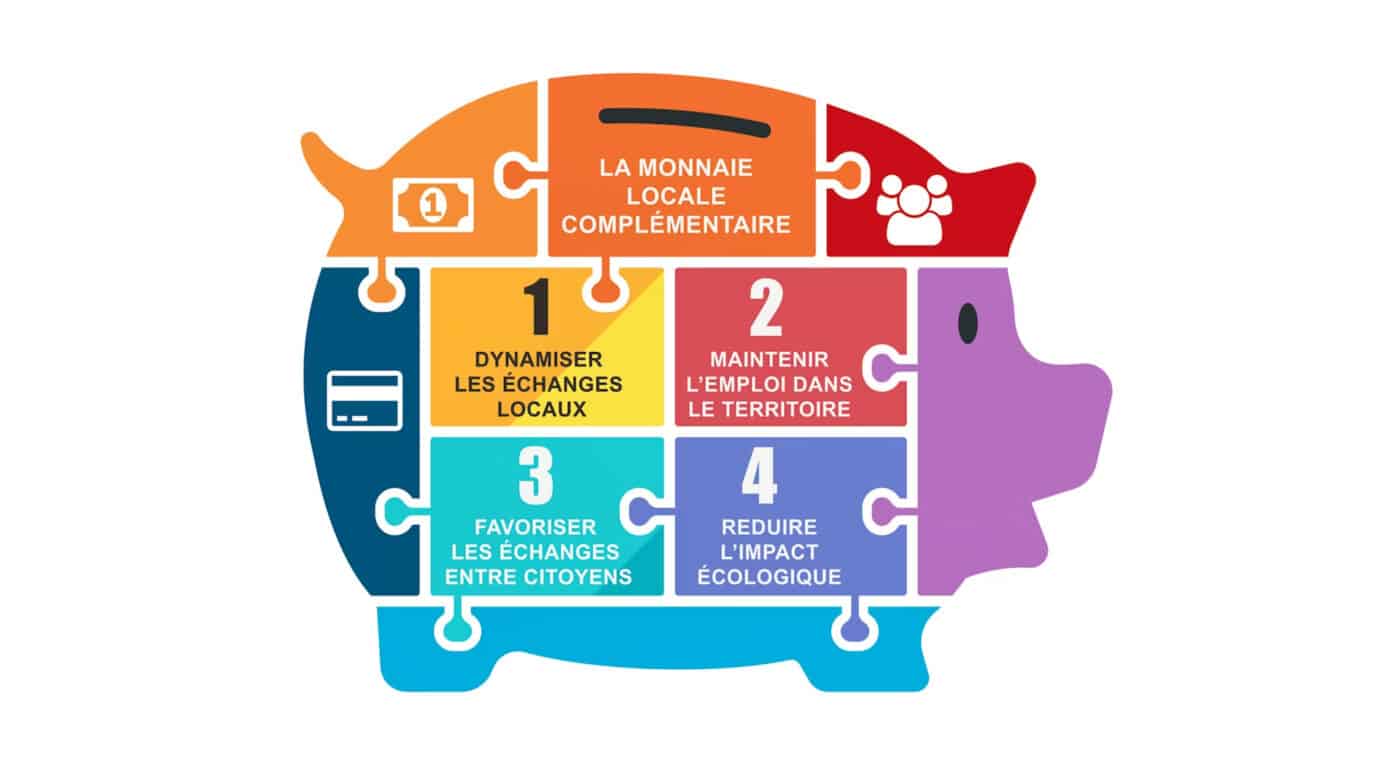
To address these challenges, some propose paying the basic income in local currency, which means a parallel currency to the euro that can only be used in a specific geographical area. We can thus imagine basic incomes paid (entirely or partially) in regional or departmental currencies, the amount of which could vary according to the standard of living in each territory.
The products and services purchasable with this local currency could be subject to strict controls, requiring, for example, that only local actors and local raw materials be involved, and that environmental standards are respected... These criteria could be defined by each region or department based on their specific needs. This new purchasing power in local currency would strongly encourage producers to adhere to the defined specifications and thus to relocalize their activities and reduce their pollution to meet this strong demand.
A lever to relocalize the economy and revitalize local areas
L’enjeu démographique lié à une immigration importante serait également limité par la faible attractivité que représente un revenu utilisable uniquement sur le territoire pour un non résident. Si elle augmente tout de même, l’immigration sera de toute façon bénéfique à l’économie locale en stimulant encore la demande en produits et services locaux. Les territoires ruraux pourraient aussi bénéficier d »un rebond démographique salutaire.
Local currencies are still underdeveloped in France (there are about thirty), but the concept is increasingly appealing to communities. However, care must be taken to ensure that these initiatives are not used to create isolated communities that favor exclusivity or even regionalism. [3]
A promising avenue still to be solidified
While more precise economic studies are still needed to verify and concretely estimate the benefits associated with paying a basic income in local currency, and to determine whether it is preferable to retain or not a portion paid in euros, the idea is promising in itself for ensuring both dignified living conditions for all individuals and a renewed economic dynamism for all territories.
In connection with these themes, Vertigo Lab is currently working with ADEME on evaluating the environmental impacts of local and complementary currencies with an environmental purpose. To learn more about this mission, click here.