The return of local in food policies
Short circuits, urban agriculture, AMAP[1], Ruche qui dit oui, locavorism[2], local food is gaining increasing popularity, now reaching French communities like the city of Albi, which has set the ambitious goal of achieving food self-sufficiency by 2020. Is this relocalization of our food consumption the solution to broader environmental challenges? Is it really achievable? How can we manage to consume 100% local products when what we eat today travels thousands of kilometers before reaching our plates?[3]
The French are becoming locavores. More than 40% of the French population frequently buys local products<[4]<, a trend that is gaining more and more followers. AMAP and Ruches continue to multiply across the territory. In 2015, The Hive that Says Yes< provided 135,000 individuals with local products[5]<.
In turn, local authorities have taken up the subject, and many of them support local agriculture and short supply chains. Some even set themselves a very ambitious goal: achieving food self-sufficiency.
Food self-sufficiency: the new El Dorado
Food self-sufficiency is the ability of a territory to meet the food needs of its population through its own resources and production. Far more ambitious than merely supporting short supply chains and local agriculture, a policy aimed at food self-sufficiency requires significant commitment from all stakeholders in the territory, from producers to consumers. The cities of Albi and Rennes have embarked on this adventure.
Food self-sufficiency in Albi
The city of Albi has set the goal by 2020 for all its residents to be able to eat products produced within a 60km radius[6].
This project has three objectives: to reduce the carbon impact related to the transportation of goods, to secure supplies in case of a food crisis, and to ensure better quality of consumed products.
To implement this ambitious policy, the city of Albi has already preempted 73 hectares of wasteland to offer them for rent to farmers at a rate of 70€ per year per hectare. In exchange, the operators commit to practicing organic farming and selling their production within a 20km radius. After four months, 8 hectares had already been leased and 7 jobs had been created.
Presented as a solution to economic, social, and environmental challenges, the relocalization of food consumption raises many questions, particularly from an environmental perspective.
Do local products really rhyme with eco-friendly?
Often associated with a more ecological mode of consumption, is local eating really more virtuous for the environment? What are the environmental benefits of relocalizing food consumption?
To address this, it is essential to look at the stages of production and distribution. Contrary to popular belief, a majority of the environmental impacts of the food chain are observed in the upstream phase of agricultural production, rather than in the transport phase. Thus, 57% of greenhouse gas (GHG) emissions occur during the production phase and only 17% at the time of transport[7]. A large part of the environmental impacts then depends on the mode of production. For example, a tomato grown in a greenhouse in winter has a higher GHG emissions impact than a tomato grown in an open field that does not require energy to heat the greenhouse. Thus, tomatoes produced and consumed in the London area have a "carbon cost" much higher than those produced in Spain and transported to London[8],[9].
Moreover, a shorter distance does not necessarily mean lower CO2 emissions per ton per kilometer. A small van that is underloaded and returns empty emits more CO2 per ton per kilometer than a cargo ship transporting large quantities over long distances in an optimized manner5, thus creating economies of scale. The challenge for proximity agriculture then lies in logistical optimization, with maximized load rates and reduced packaging waste (generally, products from short supply chains are minimally or not packaged).
However, assessing environmental impacts is not limited to just energy consumption or GHG emissions<. It is important to consider broader territorial sustainability criteria such as the preservation of agricultural land, biodiversity, water resources, and landscapes. In the face of the increasing artificialization of agricultural land, relocating food production close to consumption sites (usually cities) helps limit urban sprawl and contributes to the preservation of French agricultural land, which loses several thousand hectares each year<. Between 2006 and 2014, more than 40,000 hectares of agricultural land were artificialized[10]<, which is more than twice the area of the Hauts-de-Seine department. After the artificialization of soils, the hyperspecialization of territories poses a significant threat to biodiversity as it alters landscapes and ecosystems. By inducing diversification in production, the demand for local foods helps combat this phenomenon<.
However, one must not fall into the trap of localism by trying at all costs to produce everything on-site. Agricultural production must indeed be adapted to climatic conditions, soil type, topography, etc. Agricultural specialization has its benefits when it is well thought out and allows for resource savings, particularly in water. In a context of climate change indicating drier climates and increased pressures on this resource, it is more responsible to prioritize water-efficient crops that require little irrigation rather than trying to ensure the production of all products consumed by the population.
By relocating the impacts, the marketing of local products brings environmental benefits as production is then subject to local regulations, which are often stricter in France and Europe[11]. Furthermore, local agriculture tends to apply more sustainable practices (less reliance on inputs, respect for product seasonality, etc.) which have a positive impact on the environment. According to a study conducted in Brittany, 26 to 41% of producers report that marketing through short supply chains positively influences their environmental practices[12].
Finally, creating a green belt around cities or developing urban agriculture zones practicing responsible agriculture offers many other services that we will not detail here: improving quality of life, maintaining biodiversity, combating heat islands, etc.
To achieve a better environmental balance, the relocalization of food consumption must be done thoughtfully, optimized, and sustainably.
Food self-sufficiency: an achievable goal?
Is the quest for food self-sufficiency achievable? Desirable?
The question of achieving food self-sufficiency generates much debate and divides agronomists. However, they seem to agree that a city cannot achieve this on its own. To ensure their self-sufficiency, it would necessarily require opening the geographical perimeter to the rural periphery of the concerned city, similar to the city of Albi, which considers a radius of 60 km from its city center. We wanted to verify this statement. Are there not cities in France capable of being self-sufficient?
A French person needs an average of 0.18 hectares of cultivated land and 0.12 hectares of permanent pasture to feed themselves, according to estimates from Inra and Cirad[13]. On a national scale, the utilized agricultural area (UAA) easily meets these needs; however, not all regions have the same agricultural capacities and do not face the same demographic constraints. For Île-de-France, over 3 million hectares of agricultural land would be necessary to feed the 12 million residents, which is more than five times the current utilized agricultural area[14]. On the scale of municipalities, we calculated that out of all the cities[15] in France, 335 municipalities would have the necessary agricultural land to be self-sufficient[16]. The potential is indeed limited, with only 6.4% of French cities, but among them is a city like Arles.
Nevertheless, it is important to keep in mind that these figures remain estimates based on assumptions that do not reflect the diversity of productions necessary to meet the current dietary regime of the French. Indeed, they do not exclusively consume apples and carrots, and our food model relies heavily on imports. At the scale of Gironde, for the agricultural sector (excluding agri-food industries), the import rate is thus 61% and the export rate is 78%[17]. For comparison, the average import rate of the Gironde economy is 79%, placing the agricultural sector in relatively good standing despite the territory's inability to meet all the sector's needs. However, these rates do not mean that everything should be localized. They rather indicate the existence of a potential for local food, the possibility of local food governance. It then becomes a political choice to make, a balance to find between imports and exports. To guide this choice, a material flow assessment approach can prove to be wise. By highlighting incoming and outgoing flows, as well as potential imbalances, this approach allows for a concrete discussion of the issue of proximity agriculture. It is then necessary to consider case by case: among the products I import, which ones could I produce locally?
Food self-sufficiency in Rennes
On the scale of the city of Rennes, two prospective studies have evaluated the necessary transformations to turn its residents into locavores. Numerous land use reorientations would be required: 50% of private parks and gardens should host market gardening, as well as 40% of public gardens and 30% of squares; an agricultural belt 6.3 km wide should be established around the metropolis; 30% of forests should be dedicated to the production of nuts; etc. Furthermore, the eating habits of the population also need to be reconsidered to achieve the goal of food self-sufficiency: halve the consumption of meat and fish and triple that of vegetables[18],[19].
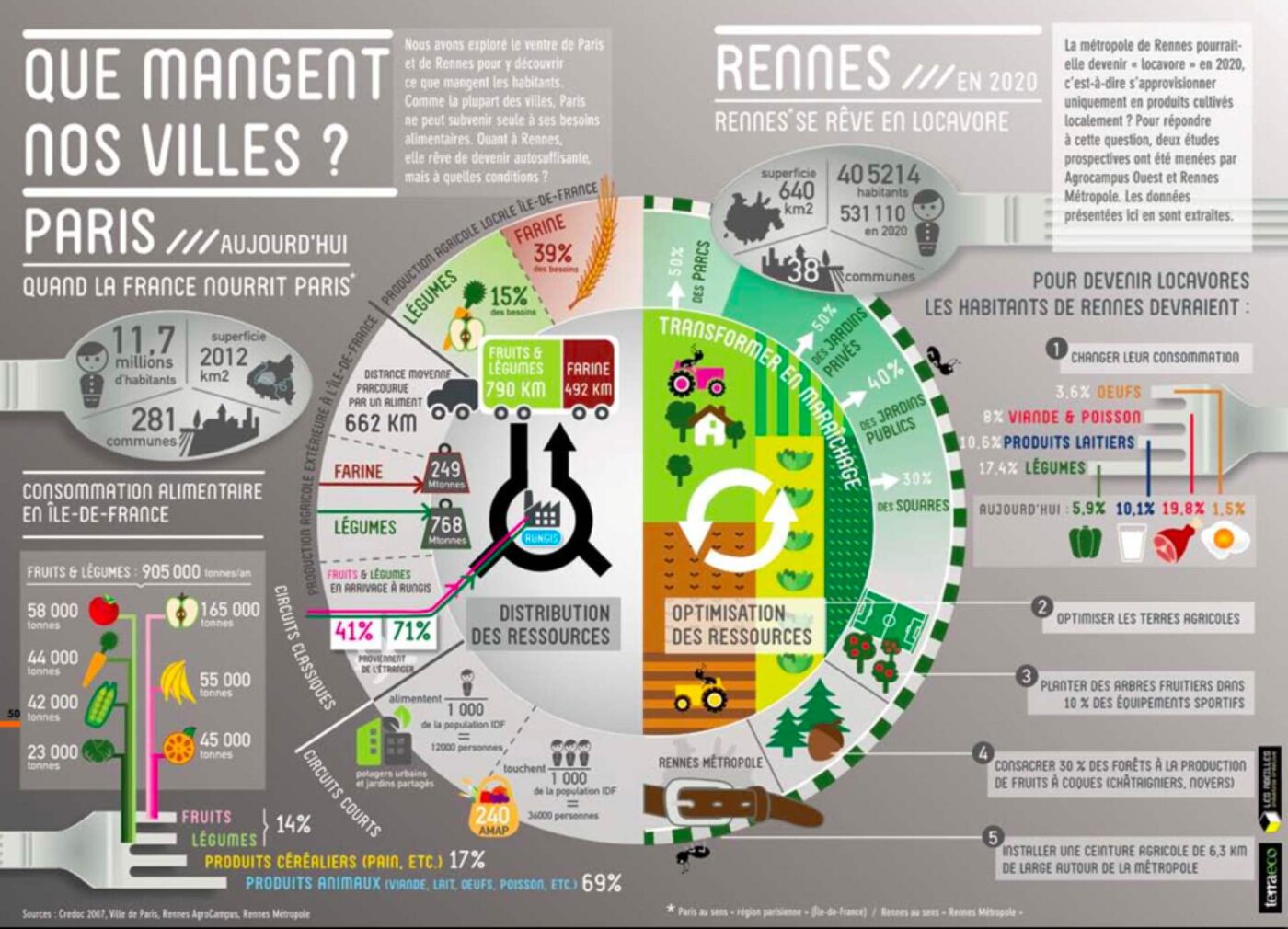
Thus, even for a city like Rennes, which benefits from significant agronomic advantages (mild climate, fertile land), the extent of the measures needed to achieve food self-sufficiency is evident. It is necessary to optimize the entire food chain, from production to distribution, with particular attention to processing tools (slaughterhouse, dairy, vegetable processing). These profound and large-scale changes are not easy to implement and require significant involvement from citizens, which is not necessarily guaranteed (how many households will agree to give up 50% of their garden for vegetable farming? what is the environmental impact of destroying forests for agricultural production?).
Thus, a whole sustainable territorial food system must be defined and integrated into governance approaches (Agenda 21, Territorial Climate Air Energy Plan, Positive Energy Territory for Green Growth) and in planning competencies (SCoT, PLU-i). It is necessary to articulate coherent territorial food projects, rethinking metropolises and agglomerations, and seeking to reconnect urban areas with rural territories. These connections can also be a driving force for rural dynamics in struggling areas. The development of proximity agriculture also helps to consolidate and build social fabrics that foster economic and social development in territories, the benefits of which we will not discuss here.
Finally, the cities that have taken on the challenge of food self-sufficiency assert themselves that it is more a matter of raising awareness, changing mindsets, and supporting short supply chains than a real goal of food autonomy that is being pursued. The idea is not to produce all the food consumed in the territory but rather to seek a production in terms of the quantity of goods placed on the market corresponding to needs. Thus, in Albi, the city hall does not plan to ban products from outside but simply seeks to secure supplies in case of a food crisis. Cities have every interest in maintaining a diversity of their food supply sources for strategic reasons and food security (Ile-de-France, for example, cannot meet its needs alone, and the city of Bordeaux reportedly has only one "day of food security"), as well as for environmental reasons (local products do not systematically have lesser environmental impacts as we have seen previously).
Food self-sufficiency should not be an objective in itself but rather the driving force behind a dynamic of intelligent food relocalization, which seeks to save land while optimizing production based on soil type, climate, and minimizing environmental impacts throughout the food supply chain, as this is where the potential for agricultural relocalization and the development of short circuits lies.
Food self-sufficiency should then remain a utopia, paving the way for awareness of the impact of our consumption on the environment, and encouraging a more sustainable agricultural production model. Far from the fortified villages of the Middle Ages stockpiling reserves in case of siege, the modern goal of food self-sufficiency should remain a pretext for the creativity of territories, for reconnecting cities and countryside, and for the multifunctionality of peri-urban spaces.
This Decryption was carried out by Vertigo Lab for La Fabrique Ecologique, a pluralistic foundation for ecology.
References
- [1] Association for the Maintenance of Peasant Agriculture, www.reseau-amap.org/.
- [2] Locavorism is a movement advocating for the consumption of locally produced food within a radius of up to 250km.
- [3] This Decryption focuses on the environmental impacts of relocating food production in the French context. It does not address socio-economic impacts or public policy issues. These topics may be the subject of future publications.
- [4]http://www.ipsos.fr/sites/default/files/attachments/les_francais_et_le_consommer_local_12_fevrier_2014.pdf
- [5] https://reporterre.net/La-Ruche-qui-dit-oui-uberise-t-elle-le-systeme-Amap
- [6] http://www.mairie-albi.fr/food-self-sufficiency-in-albi
- [7] http://www.developpement-durable.gouv.fr/IMG/pdf/LPS158.pdf
- [8] Department for Environment, Food and Rural Affairs) : “Comparative life-cycle assessment of food commodities procured for UK consumption through a diversity of supply chains », London, 2008.
- [9] This analysis focuses solely on the "carbon cost" and does not take into account other major environmental criteria such as water consumption, which is an important issue for a country like Spain but less so for England. As highlighted later, we should not stop at just the GHG balance but consider all environmental impacts.
- [10] http://agreste.agriculture.gouv.fr/IMG/pdf/primeur326.pdf
- [11]http://www.ademe.fr/sites/default/files/assets/documents/avis_ademe_circuits_courts_alimentaires_proximite_avril2012.pdf
- [12] CIVAM Brittany. Environmental performance of short circuits. September 2013.
- [13] www.iufn.org/wp-content/uploads/2013/05/Nourrir_nos_villes1.pdf
- [14] INSEE data, and Agreste for the year 2014. http://driaaf.ile-de-france.agriculture.gouv.fr/IMG/pdf/2103_Memento_2014_version_pour_imprimeur_17_11_14_ANNIE_cle06c1f1_cle064d3e.pdf
- [15]< We considered as cities the municipalities with more than 2,000 inhabitants (INSEE definition).
- [16] Estimates Vertigo Lab based on data from Inra, Cirad, and Agreste 2010.
- [17] Estimates Vertigo Lab.
- [18] http://encyclopedie-dd.org/encyclopedie/terre/5-2-les-differents-secteurs/rennes-ville-vivriere.html
- [19] www.imagiter.fr/2016/10/when-cities-organize-food-self-sufficiency.html