Each week, the Lab selects a document or project deemed particularly interesting and relevant and presents it in a few lines. This week in the Lab's selection, we invite you to take stock of some applications and initiatives inspired by the mobile game Pokémon GO.
Pokémon GO: a cultural phenomenon… and an unexpected opportunity
Qui n’a pas entendu parler de Pokémon GO ? Véritable phénomène de l’été 2016, l’application mobile a séduit des millions d’utilisateurs à travers le monde : depuis les fans inconditionnels du célèbre manga des années 2000 jusqu’à la Première ministre norvégienne Erna Solberg [1]. Le jeu en réalité augmentée a suscité un tel engouement que durant plusieurs semaines, il était quasiment impossible de fréquenter les lieux publics sans croiser un dresseur de Pokémon ou affronter une meute de joueurs tentant d »attraper un spécimen particulièrement rare. Et pour cause : le jeu a été téléchargé plus de 100 millions de fois depuis son lancement en juillet dernier.
At the boundary between the real world and the virtual world, Pokémon GO raises numerous debates. While some see this game as just another step towards the virtualization of our society or a hunt for personal data, others find many benefits in it. It is said to have a positive impact on health (both mental and physical). By forcing players to step outside their four walls, it indeed fights against sedentary behavior. It also allows for easier socialization and can even be a source of education. By creating their Pokédex, a tool for cataloging captured Pokémon species, users would, for example, through the parallel with real animal species, become more aware of biodiversity.
Gamification in the service of the environment
Mais pourquoi ne pas profiter de ces nouvelles technologies, des outils de géolocalisation et des caméras de smartphones à notre disposition pour encourager les changements de comportement et notamment en matière de préservation de l’environnement ? C »est le concept désormais bien connu de « gamification » (ludification en français), visant à encourager les bons comportements à travers une démarche ludique [2]. Cette question, d’autres utopistes se la sont posée et se sont inspirés de Pokémon GO pour relever le défi.
Pokédéchets GO: catch waste rather than Pokémon
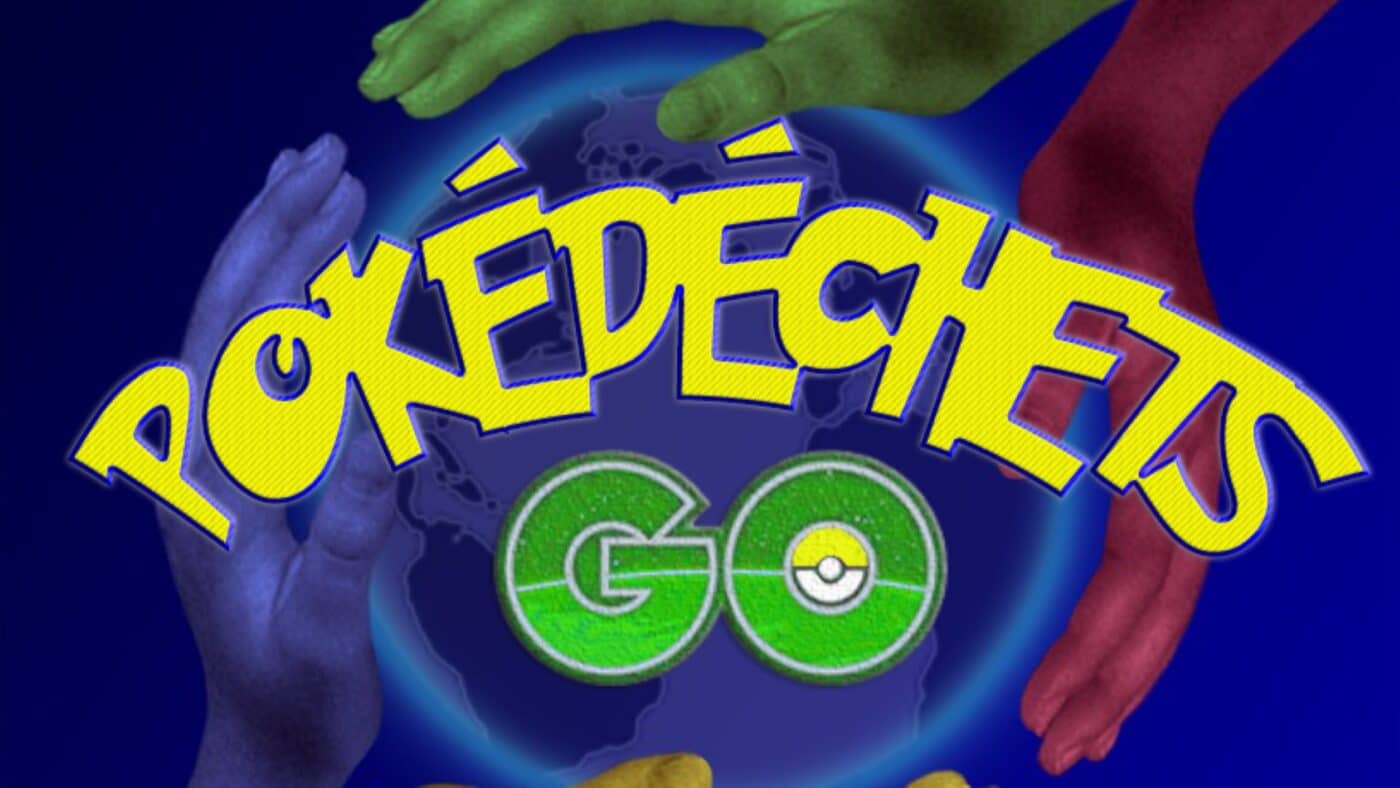
This is the case for Gabriel Michenzi, Luis Ferreira, and Arnaud Martig, three young Swiss who created the game Pokédéchets GO. As you might have guessed, in this game, it's no longer about hunting wild Pokémon but rather about collecting wild waste. Players, equipped with trash bags and gloves, must pick up as much litter as possible and share a photo of their haul on the game's Facebook page [3]. Each month, the largest collections are rewarded [4]. The photo below illustrates the result of a cleanup carried out through Pokédéchets GO.

Hoali and initiatives to clean up the oceans
On the same theme, Alexandre Solacolu, Philippe Carrez, Buno Sroka, and Hugues Bosvieux, hailing from Saint Brieuc, are currently developing the app Hoali [5]. Here, the goal is to rid the oceans of waste by collecting it before it reaches them. Available in a few weeks, the app will indicate to the user the nearest trash can, similar to a Pokéstop, for disposing of their collected waste. Each player will also be able to map missing trash cans on the interactive map. This game does not offer rewards for users, but what could be more rewarding than participating in the preservation of the oceans! Players will also be able to measure the impact of their actions on the health of the oceans.

During the third Atlantic stakeholders' conference held in Dublin on September 27, where Vertigo Lab led a workshop on open innovation, a working group dedicated to the issue of marine waste also raised the idea of a Pokétrash GO. This reflection stemmed from the observation that awareness-raising actions, such as beach clean-up operations, remain too sporadic. The option of gamifying coastal waste collection was therefore explored to make this action more appealing. The ideas that emerged from this working group converged towards the development of an application inspired by Pokémon GO, coupled with a points system rewarding the best waste collectors. The accumulated points could allow them, for example, to receive promotional offers from local merchants who have adopted waste and packaging reduction policies.
From punitive ecology to playful ecology
The incentive and playful nature is the main common point among these various initiatives. From the ban on very old cars in downtown Paris to the implementation of an eco-tax, punitive ecology, which points out bad behaviors, is far from unanimous. The initiatives presented in this article, on the contrary, rely more on the training effect by playing on the playful aspect of the approach and showing the importance of the individual scale. Individual behavior, often drowned out by collective behavior when it comes to denouncing environmental issues, is here revalued. Moreover, applications like Hoali, which measure the impact of the action taken by the player, have the advantage of translating their action into a concrete result, which can further motivate commitment in the medium term.
The sustainability of these initiatives can still raise questions. Apps like Pokémon Go are often linked to a trend effect: two months after its release, the game's success is already waning. To advocate for environmental causes in a more sustainable way, the development of eco-responsible nudges presents itself as an alternative solution. Born from behavioral economics research, nudges aim to encourage individuals to change their behavior without using guilt or punishment. At their next seminar, the team from Vertigo Lab will attempt to develop and test a green nudge in one of the cities in the southwest. We’ll share more details in a few weeks…
References
- [1] http://www.lexpress.fr/insolite/norvege-la-premiere-ministre-surprise-en-train-de-jouer-a-pokemon-go_1838517.html
- [2] For more information on this topic, you can check the 2013 special issue of Courrier International at the following address: http://www.courrierinternational.com/magazine/2013/2013-4-life-is-a-game
- [3] To visit the game's Facebook page: https://www.facebook.com/PokeDechetsGo/
- [4] The rewards are only revealed once the winner is identified.
- [5] To visit the Hoali page: http://hoali.org/