
Every week, the Lab selects a news item deemed particularly interesting and relevant and presents it in a few lines. This week, the Lab focuses on the Green Climate Fund ((or, GCF in English) originates from the promise made at the Copenhagen conference (COP15, [[NUM]]) by developed countries to participate in financing adaptation and mitigation projects for climate change in developing countries. Funding is expected to reach [[PRICE]] billion per year by [[NUM]]. This commitment responds to one of the fundamental (and still debated) principles of climate negotiations, that of "common but differentiated responsibility" of all countries in global warming, with historically higher emissions from industrialized countries that must therefore help other countries develop sustainably [1].), which has been the subject of a infographic created by So far, the promises of funding come from around forty States, Regions, and Cities and represent 10 billion dollars per year. An important sum, but still far from the target to be achieved. However, total investments from industrialized countries for the sustainable development of less developed countries are estimated by the OECD at [[NUM]] billion dollars in [[NUM]], compared to [[NUM]] billion in [[NUM]][[[NUM]]]. An encouraging trend, even if the calculation methods used are heavily criticized by some developing countries, particularly India[[[NUM]]]. Indeed, the investments considered in the study are often loans rather than grants, or even export credits for which it is difficult to measure the true environmental added value. The designation of "climate project" is also widely used for communication purposes, without always meeting rigorous characterization criteria[[[NUM]]]., an international student think tank for climate innovation.
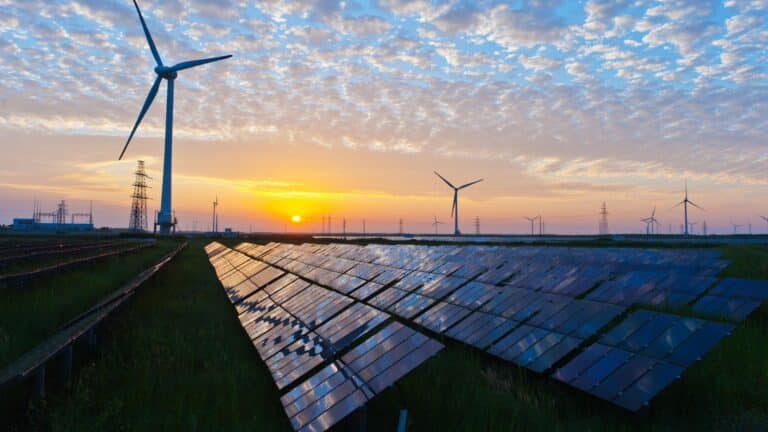
Cover image: The first projects financed by the Green Climate Fund (click here< to access the complete infographic).
Origin and ambition of the Green Climate Fund
The (or, GCF in English) originates from the promise made at the Copenhagen conference (COP15, [[NUM]]) by developed countries to participate in financing adaptation and mitigation projects for climate change in developing countries. Funding is expected to reach [[PRICE]] billion per year by [[NUM]]. This commitment responds to one of the fundamental (and still debated) principles of climate negotiations, that of "common but differentiated responsibility" of all countries in global warming, with historically higher emissions from industrialized countries that must therefore help other countries develop sustainably [1]. (or (or, GCF in English) originates from the promise made at the Copenhagen conference (COP15, [[NUM]]) by developed countries to participate in financing adaptation and mitigation projects for climate change in developing countries. Funding is expected to reach [[PRICE]] billion per year by [[NUM]]. This commitment responds to one of the fundamental (and still debated) principles of climate negotiations, that of "common but differentiated responsibility" of all countries in global warming, with historically higher emissions from industrialized countries that must therefore help other countries develop sustainably [1]., GCF in English) originates from the promise made at the Copenhagen conference (COP15, 2009) by developed countries to participate in financing adaptation and mitigation projects for climate change in developing countries. Funding is expected to reach $100 billion per year by 2020. This commitment responds to one of the fundamental (and still debated) principles of climate negotiations, that of "common but differentiated responsibility" of all countries in global warming, with historically higher emissions from industrialized countries that must therefore help other countries develop sustainably [1].
The creation of the Green Climate Fund was established in 2010 in Cancun (COP16) as an operational entity emanating from the UNFCCC, the United Nations Framework Convention on Climate Change, with its headquarters located in Songdo, South Korea. The Green Climate Fund aims to implement the financial mechanisms of the Convention and to become the reference recipient of the annual $100 billion, alongside other funds and development banks. The Paris Agreement (COP21) stipulates that these funds will increase, with a first meeting scheduled for 2025 to make new commitments in favor of the poorest countries. Furthermore, developing countries can now participate in the Fund voluntarily: Mongolia, Vietnam, Colombia, Mexico, and others have already announced contributions.
Funding promises still insufficient
So far, the promises of funding come from around forty States, Regions, and Cities and represent 10 billion dollars per year. An important sum, but still far from the target to be achieved. However, total investments from industrialized countries for the sustainable development of less developed countries are estimated by the OECD at 62 billion dollars in 2014, compared to 52 billion in 2013[2]. An encouraging trend, even if the calculation methods used are heavily criticized by some developing countries, particularly India[4]. Indeed, the investments considered in the study are often loans rather than grants, or even export credits for which it is difficult to measure the true environmental added value. The designation of "climate project" is also widely used for communication purposes, without always meeting rigorous characterization criteria[5].
In detail, the largest contributors to the Green Climate Fund per capita are Luxembourg ($94 / inhabitant), Sweden ($60 / inhabitant), and Norway ($50 / inhabitant). France ranks 6th in this ranking ($16 / inhabitant) and Paris is the first city to have independently committed, amounting to $1.3 million [6].
Concrete projects and a discussed leverage effect
In November 2015, 8 initial projects were validated in Senegal, Malawi, Fiji, Bangladesh, Peru... and they address both adaptation and mitigation to climate change. The contribution from the Green Climate Fund enables the mobilization of significant public and private funds, and ultimately represents only 13% of the overall budget for these projects: 1 € invested by the Fund corresponds to almost 7 € invested by other actors! This leverage effect is known, but its actual effectiveness is debated: how can we be sure that the projects would not have been realized without the Fund's intervention? Moreover, a strong leverage effect for financing does not necessarily translate into greater reductions in CO2 emissions [7]. Despite these questions, the 100 billion dollars per year are likely to more broadly stimulate the design and financing of climate-related projects[8].
A system still under construction
The story of the Green Climate Fund is therefore just beginning. Its effectiveness will largely depend on its ability to achieve its initial goal and to ensure that donor commitments are respected in the long term, without replacing existing national initiatives: the Green Climate Fund cannot simply be a conduit for investments. Transparency in the management of spent amounts and on the concrete results of funded projects is another major issue for sustaining the system and the trust of the stakeholders involved.
References
- [1] The Copenhagen Accord, Ministry of Environment, Energy and the Sea, http://www.developpement-durable.gouv.fr/L-Accord-de-Copenhague,21485.html
- [2] The momentum for climate financing is given, OECD, http://www.oecd.org/fr/presse/l-elan-du-financement-climatique-est-donne.htm
- [3] More details on the Paris Agreement, COP21, http://www.cop21.gouv.fr/decryptage-de-laccord/<
- [4] India questions OECD claim on climate finance, The Hindu, http://www.thehindu.com/news/national/oecd-report-on-climate-change-fund-flows-flawed-finance-ministry/article7930104.ece
- [5] OECD estimates climate finance flows at $60 billion, Climate Home, http://www.climatechangenews.com/2015/10/07/oecd-estimates-climate-finance-flows-at-60-billion<
- [6] Contributions to the Green Climate Fund by State, Region, and City, http://www.greenclimate.fund/contributions/pledge-tracker
- [7] Private leverage achieved by different instruments varies depending on the definition and context, World Economic Forum, http://reports.weforum.org/green-investing-2013/leveraging-private-investment/
- [8] Negographics #2, CliMates, https://studentclimates.files.wordpress.com/2016/05/gcf-negographics.jpg