
Wetlands are terrestrial environments that are usually flooded or saturated with water (either permanently or temporarily), where specific vegetation composed of hygrophilous plants (which have high water and humidity needs) is found. While debates still exist today regarding the definition of wetlands, the international scientific community agrees to recognize them as environments where land and water meet.

Recent studies estimate that wetlands cover nearly a quarter of the metropolitan territory (source: Data and statistical studies 2022 from the Ministries of Territories, Ecology, and Housing). They can be found scattered throughout our environment, playing a central role for biodiversity.
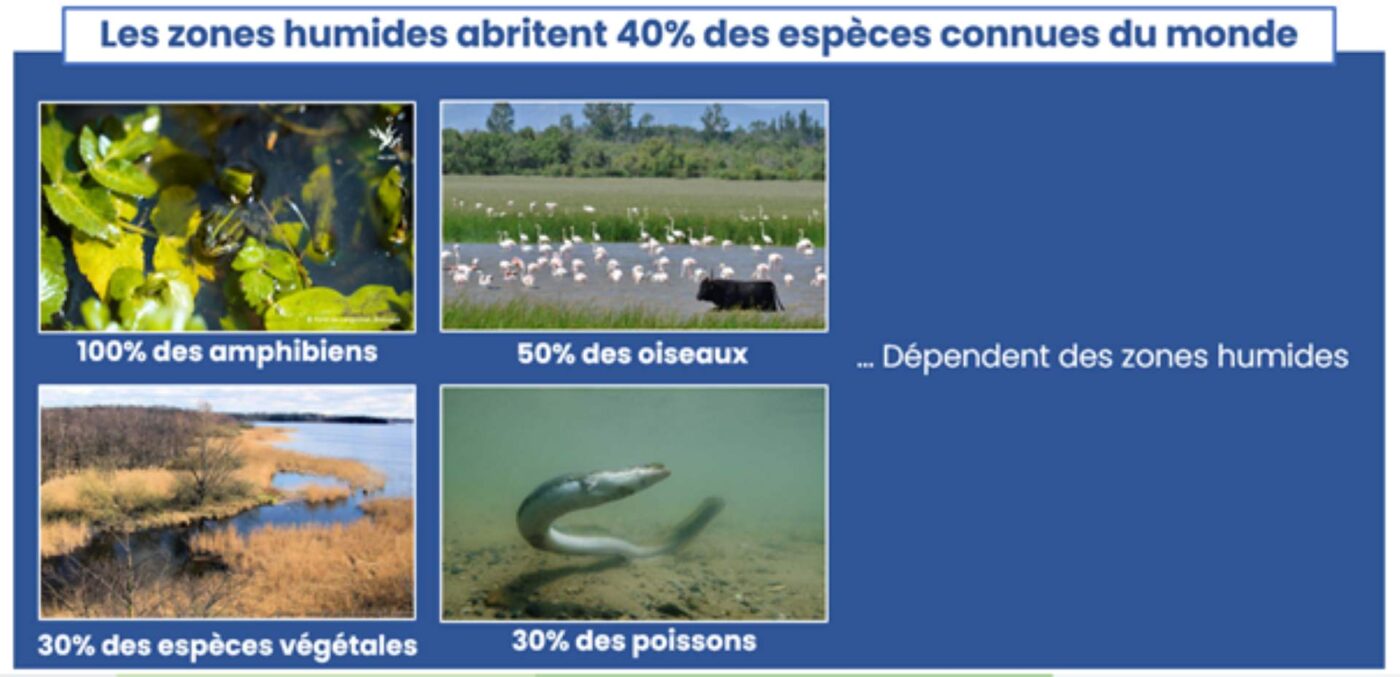
What are the benefits of wetlands for society?
Wetlands, thanks to their multiple ecological functions, provide numerous benefits (known as "ecosystem services") for human society. Vertigo Lab has been working for over a decade on the economic assessment of these types of benefits. Here are some major examples:
Contribution to climate change mitigation through carbon sequestration

The storage of rainwater by the reserve thus helps combat the risks of flooding downstream of the basin (during intense rainfall events) and is likely to support low water flows in rivers during warm and/or dry periods. More specifically, the natural environments of Pinail are capable of storing up to 390,000 m3, before gradually releasing them into the watershed (source: RNN of Pinail & ENVOLIS, 2024).
These GHG emissions are avoided by protecting this exceptional site under the status of National Nature Reserve, and through the management of natural environments practiced by CEN Nouvelle Aquitaine.
Contribution to mitigating the risks of marine submersion
In coastal areas, wetlands can combat the risk of marine submersion in various ways, including:
- By sponge effect: the wetland reduces the volume of seawater that can enter the land through absorption and storage.
- By barrier effect: the wetland physically protects populations located inland by reducing wave force and swell dynamics, as well as slowing down water runoff (compared to an impermeable flat surface).
In 2015, Vertigo estimated that the wetlands of the Conservatoire du Littoral located in the Domaine de Certes and Graveyron, the Iles de Malprat, and the Domaine Fleury on the Bassin d'Arcachon (Gironde, 33) were protecting the area from the risks of marine submersion.
The damages could cost at least 3,600,000€ additional to the community, compared to a situation where these wetlands would be destroyed (Vertigo Lab, 2015).

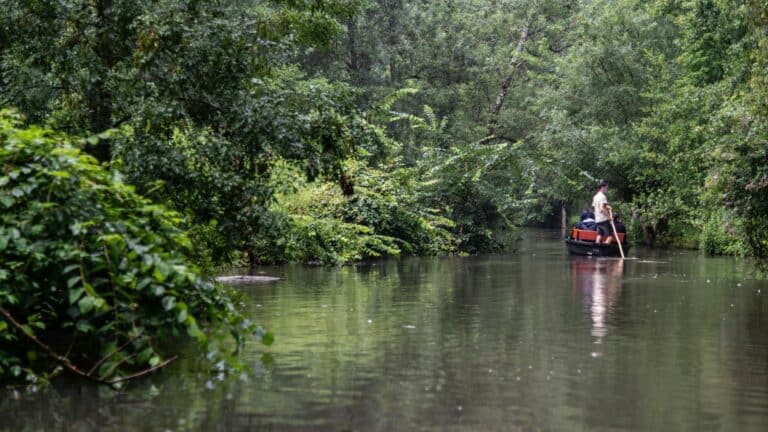
The National Nature Reserve (RNN) of Pinail (Vienne, 86) is a vast wetland capable of storing water during precipitation events and releasing it during dry periods.
A pond in the RNN of Pinail © Anthony Ruiz

The floodplains of the Sensitive Natural Area (ENS) of the Bocage de Garonne (Gironde, 33) are capable of filtering phosphorus (an agricultural pollutant) present in the Eau Blanche, a stream located on the edge of the ENS. Vertigo Lab has estimated that this retention capacity is around 5,000 kg P/year for the 316 ha of floodplains of the Bocage de Garonne. This annual filtration capacity would cost between 26,070 and 139,830€/year if it were carried out by a treatment plant (source: Vertigo Lab, 2024).
At Vertigo Lab, we work closely with key players in restoration and conservation (Conservatoire du littoral, Natural Reserves of France, Conservatories of Natural Spaces, the French Office for Biodiversity, local authorities, etc.) and with the research community (notably through European projects such as the Horizon Europe project RESTORE4Cs) to reveal the importance of wetlands and shift towards better integration of these into political and economic decisions.
[[NUM]] [[NUM]] kg P/year
The wetland resource center: https://www.zones-humides.org/
On a global scale, 87% of the wetlands present in the 17th century no longer existed by the year 2000 (with half lost during the 20th century). In metropolitan territory, 50% of wetlands would have disappeared between 1960 and 1990 (Bernard Report, 1994).
On a global scale, [[NUM]]% of wetlands present in the 17th century no longer existed by the year [[NUM]] (half of which were lost during the 20th century). In the metropolitan territory, [[NUM]]% of wetlands would have disappeared between [[NUM]] and [[NUM]] (Bernard Report, [[NUM]]). The main causes are as follows: the development of urbanization and infrastructure, the intensification of agriculture and aquaculture, the conversion and afforestation of agricultural land, river management, water extraction, material extraction, and the arrival of invasive exotic species.

At Vertigo Lab, we work closely with key players in restoration and conservation (Conservatoire du littoral, Natural Reserves of France, Conservatories of Natural Spaces, the French Office for Biodiversity, local authorities, etc.) and with the research community (notably through European projects such as the Horizon Europe project
At Vertigo Lab, we work closely with key stakeholders in restoration and conservation (Coastal Conservatory, Natural Reserves of France, Conservatories of Natural Spaces, the French Office for Biodiversity, local authorities, etc.) and with the research community (notably through European projects such as the Horizon Europe project RESTORE4Cs) to reveal the importance of wetlands, and shift towards better integration of these in political and economic decisions.
To go further
image article wetlands definition benefits society
image article wetlands definition benefits society image1
- The international convention on wetlands (RAMSAR): https://www.ramsar.org/fr
- The Mediterranean alliance for wetlands: https://medallianceforwetlands.org/
- The Mediterranean Wetlands Initiative (MedWet):
https://medwet.org/fr/ - Wetland Based Solutions: https://www.wetlandbasedsolutions.org/
- LinkedIn group for sharing best practices aimed at wetland restoration professionals: https://www.linkedin.com/groups/10046631/
- Wetland Based Solutions: https://www.wetlandbasedsolutions.org/
- LinkedIn group for sharing best practices aimed at wetland restoration professionals: https://www.linkedin.com/groups/10046631/
This popular science article fits within an analysis framework of work carried out by Vertigo Lab at sites located in mainland France.